On Tough Trust

Ideas worth trusting.

Pete's films and reflections on trust, leadership, and the culture that keeps fraud and dishonesty out of great organisations.

Films

Short films on the Method.

Most watched

Truth comes first

Great leaders don't manage the truth — they surface it. Pete explains why CEOs and their teams should give the Board the bad news first, fast and unvarnished, and how that single habit builds the trust that keeps nasty surprises, and fraud, out of an organisation.

Unscheduled deep dives

One of the most powerful tools a Board has is the freedom to drop into any part of the business, unannounced. Pete shows how random, unscheduled deep dives keep everyone honest — because no polished quarterly performance can survive a spotlight it never saw coming.

No secret zones

Fraud composts in closed rooms. Pete makes the case for 'no secret zones' — every division, joint venture and special project kept in scope, the walls between them removed, and openness set as the default right across the organisation.

The library

The Tough Trust library.

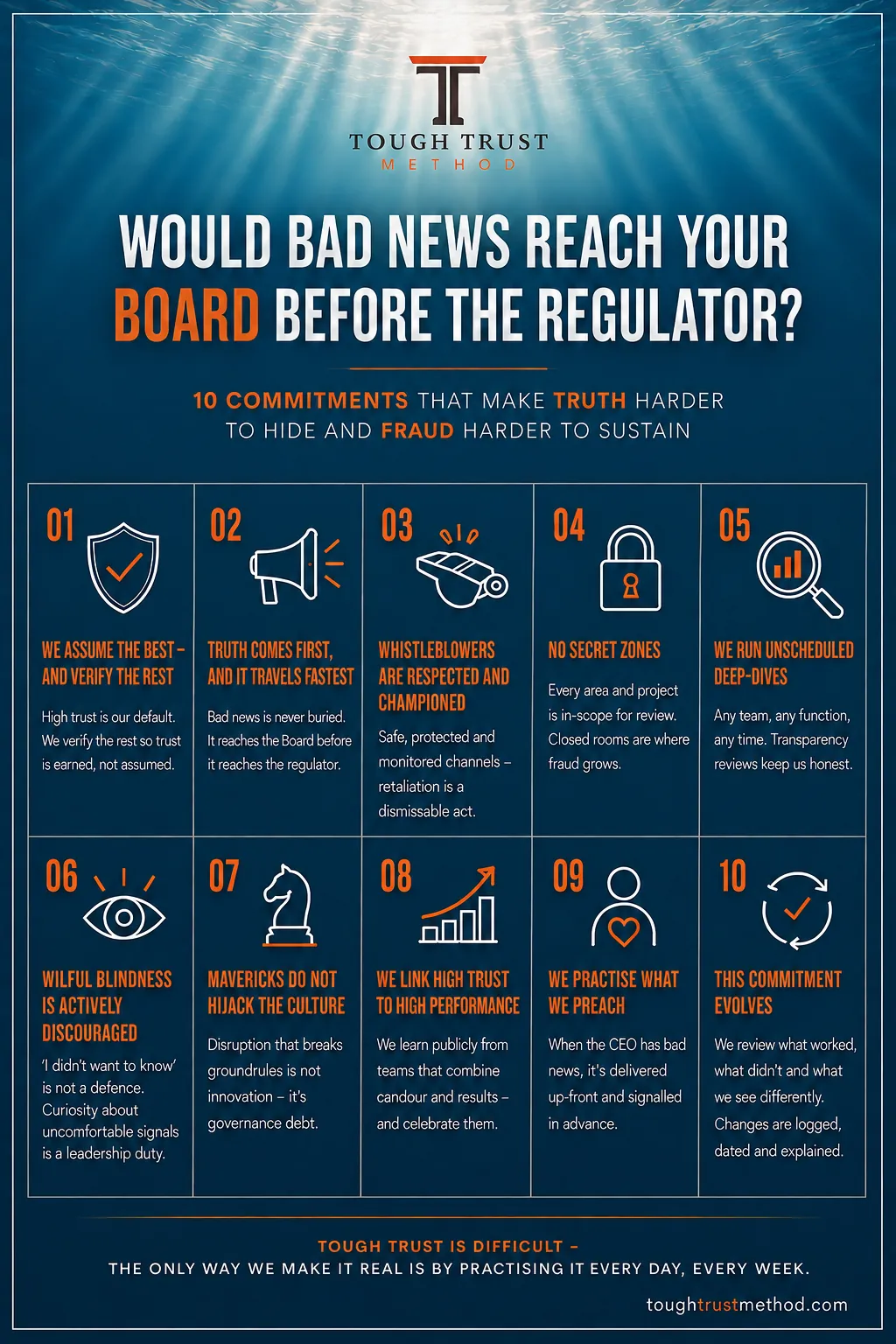
Infographic of the ten Tough Trust commitments, each with its own icon, on a deep blue underwater background.

Would bad news reach your Board before the regulator?

Boards always want to assume that bad news will reach them before their regulator. But the truth often travels too slowly for that. The question for every Board is simple: how do you speed up the circulation of truth, so you know the real story before any outsiders? The Tough Trust Method is built around ten top-level commitments that make bad news easier to raise, harder to soften and faster to escalate. They are not slogans. They are working disciplines, including trust with verification, no secret zones, protected whistleblowing, unscheduled deep dives and active curiosity about uncomfortable signals. Fraud and dishonesty find space in delay, silence, polished reporting and private exceptions. The ten commitments make truth harder to hide and fraud harder to sustain.

Two business people in suits poised to dive from facing ledges into deep blue water, with sunlight streaming down from the surface.

Unscheduled deep dives led by Non-Execs

The defining issue of leadership today comes down to one thing above all else: the struggle for the truth. Deep dives have worked well in many Boardrooms. The next step is to use them to build closer links between Boards and senior leaders: unscheduled, informal deep dives, each led by one or two Non-Executive Directors with a small group of senior leaders. The NEDs open by saying to a Chief Officer and their team: "We've seen the performance data already. We want you to tell us what's keeping you awake at night, and where you're most determined to make improvements." The first groundrule is that the truth comes first. No PowerPoint, no glossing over poor performance: the unvarnished truth, not the truth as some might like it to be. Senior leaders should expect to feel vulnerable. It feels tough at first, and risky. But that risk is what builds trust, and it helps everyone sign up to the outcomes they agree.
The same businesswoman shown twice, pulling on opposite ends of an orange rope with a knot in the middle, one tense and one relaxed.

The tug of war inside us as leaders

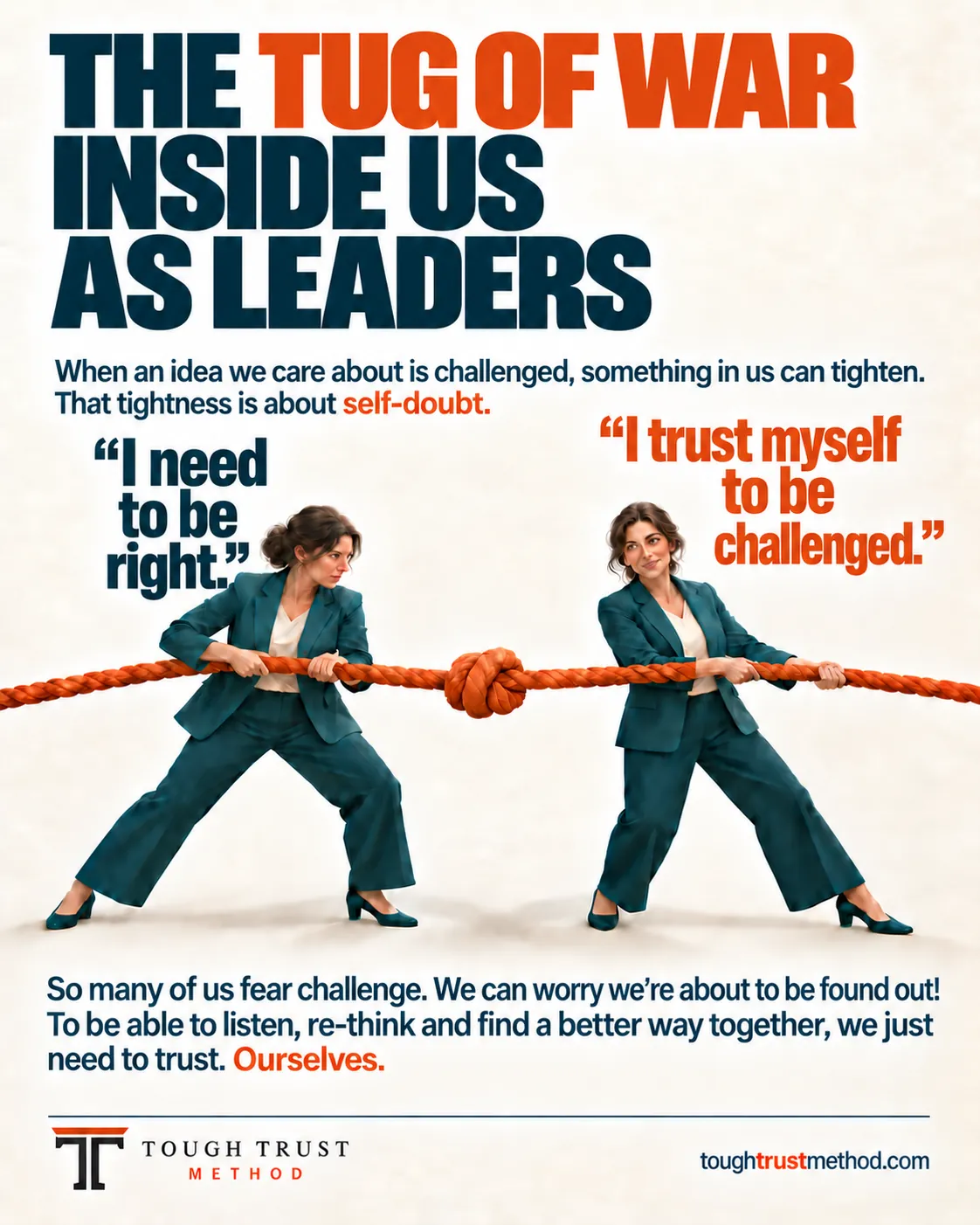
How do you feel when you're challenged as a leader? It's a question many of us don't ask, and it may be why so many of us over-react to challenge. When an idea we care about is challenged, something in us can tighten. That tightness is about self-doubt. One voice says, "I need to be right." The other says, "I trust myself to be challenged." So many of us fear challenge and worry we're about to be found out. But to listen, re-think and find a better way together, the trust we need isn't in others. The real issue isn't "us and them". It's about us and ourselves.
A single orange paper boat leading a fleet of white paper boats towards a target.

Winning the argument is not the same as leading well

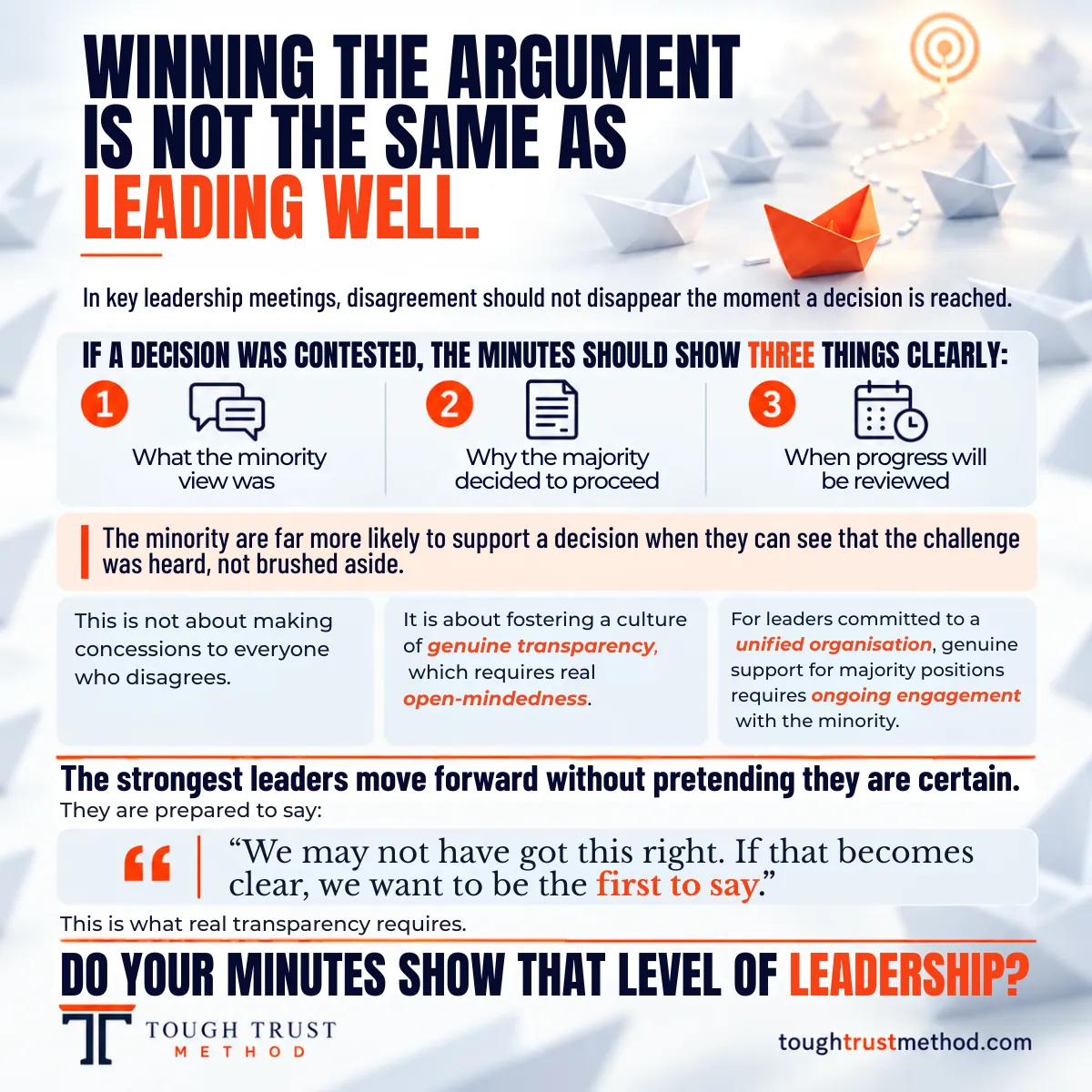
In so many teams, we still handle disagreement badly. In key leadership meetings, disagreement should not disappear the moment a decision is reached. If a decision was contested, the minutes should show three things clearly: what the minority view was, why the majority decided to proceed, and when progress will be reviewed. The minority are far more likely to support a decision when they can see their challenge was heard, not brushed aside. This is not about making concessions to everyone who disagrees. It is about a culture of genuine transparency and open-mindedness. The strongest leaders move forward without pretending they are certain. They are prepared to say: "We may not have got this right. If that becomes clear, we want to be the first to say." Do your minutes show that level of leadership?
We need a new deal for whistleblowers

We need a new deal for whistleblowers

So many organisations let down whistleblowers, even those with a Whistleblower Champion sitting on their Board. Too often, it still costs someone their career the moment they put their name to a concern. It's no wonder that 69% of whistleblowing reports to UK organisations are made anonymously. Even then, a 2024 analysis by the UK whistleblowing charity Protect found that more than two thirds of the whistleblowers it helped faced victimisation or felt forced to resign. Far too many reports fall on deaf ears because the channels are one-way. When a concern lands on a Whistleblower Champion's desk with no way to ask a follow-up question, the investigation stalls, the concern goes nowhere, and the person who took the risk is left wondering why they bothered. It doesn't have to be this way. Modern end-to-end encrypted platforms let organisations hold secure, two-way dialogues with whistleblowers, asking questions and building a robust case without compromising their identity. Boards that have appointed a Whistleblower Champion have already made a vital commitment. Now it's time to give them the tools to make it real.
Calling a pause when Boardroom conflict escalates

Calling a pause when Boardroom conflict escalates

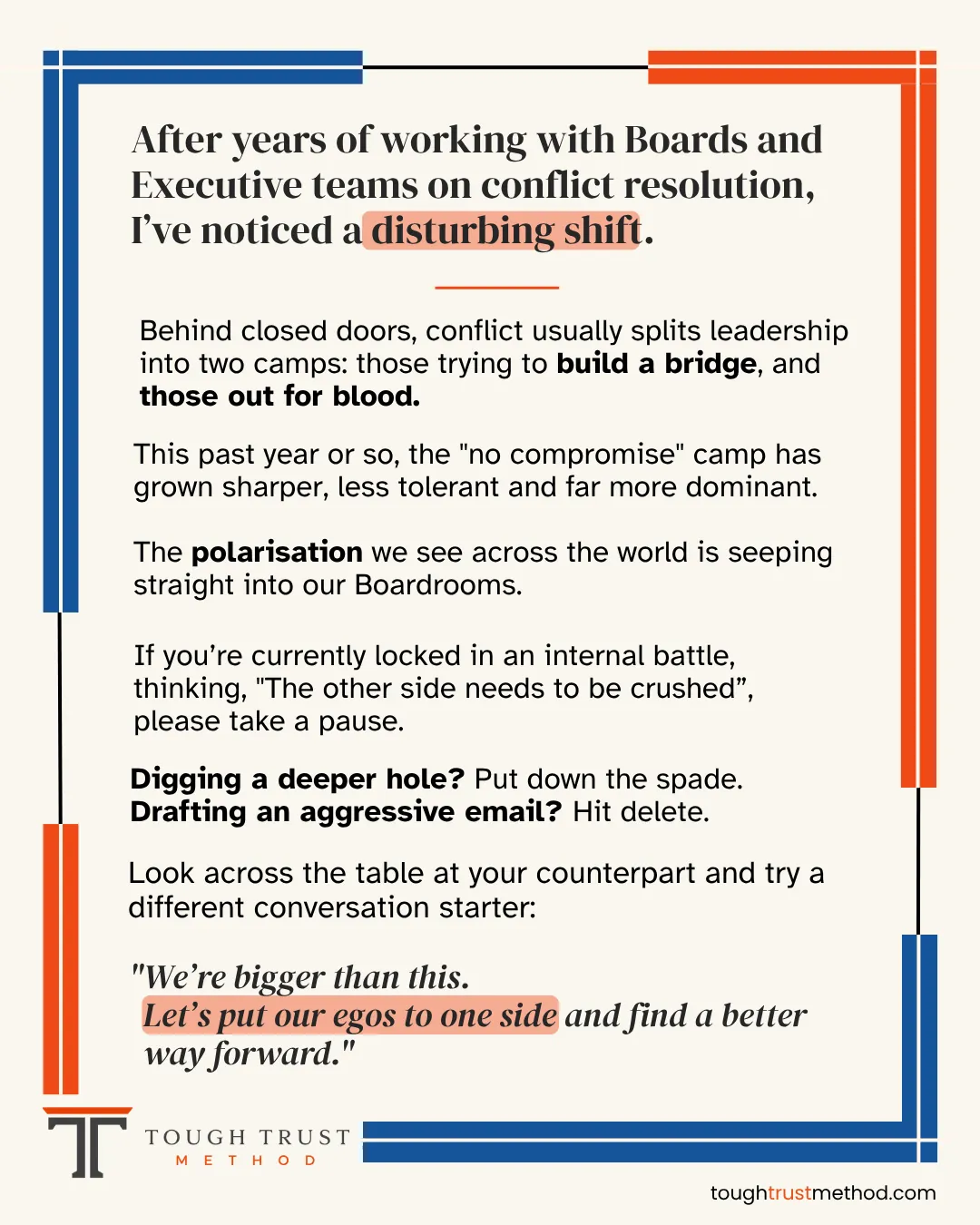
Growing polarisation in society is causing havoc in many Executive teams and Boards. More are riven by conflict for longer, and no one gains. After years of working with Boards and Executive teams on conflict resolution, I’ve noticed a disturbing shift. Behind closed doors, conflict usually splits leadership into two camps: those trying to build a bridge, and those out for blood. This past year or so, the “no compromise” camp has grown sharper, less tolerant and far more dominant. When I help organisations through the aftermath of Executive fallout, I hear the same two sentences from CEOs and Chairs time and again: “It just got out of control” and “If only we’d taken a pause.” If you’re locked in an internal battle, take that pause. Digging a deeper hole? Put down the spade. Drafting an aggressive email? Hit delete. Then look across the table at your counterpart and try a different conversation starter: “We’re bigger than this. Let’s put our egos to one side and find a better way forward.” Knowing when to call time out isn’t weak leadership. It can take real courage to ask your peers to step past egos and build bridges instead of walls.

A personal note

Pete also coaches one-to-one.

Alongside his work with Boards and top teams, Pete takes on a small number of one-to-one coaching clients each year – CEOs, Directors and Board Chairs. If you'd like to explore working together, email Pete directly – he reads every message personally and replies within 48 hours.

pete@peteashbycoaching.com

Get Pete's next film.

A short, no-nonsense film on trust and leadership, straight to your inbox – no more than once a month.

Start the conversation

Bring Tough Trust to your Board.

pete@peteashbycoaching.com
Tough Trust Method

A Board-level commitment that combines high trust with rigorous, transparent processes – so the fraudster and the disruptive maverick never get to define your organisation's culture.

Get in touch directly

pete@peteashbycoaching.com

© 2026 Pete Ashby · The Tough Trust Method. All rights reserved.

Website designed by Evie Ashby · Ashby London Ltd.